Showing posts with label vegan. Show all posts

Sunday, July 22, 2012

Vegan Mashed Cauliflower with Marinated Mushrooms or Mushroom Spinach Marsala- How I Learned To Live Without Take-Out, Part 3

When I began to convert the take-out recipes I loved to low carb, my initial attempt was Mushroom and Spinach Marsala. I was weaning myself off of the take-out, but was still relying on the few low carb options available in Berkeley, CA. One of these was a grilled chicken breast topped with mushroom and spinach marsala. While I couldn't be certain, I suspected the restaurant had prepared this dish using corn starch and/or white flour as thickeners. I didn't even want to guess what other ingredients might be involved so I started researching marsala recipes on the internet. It was easy enough to convert the recipe substituting xanthan gum as the thickening agent. A small amount yields the same results as the other thickeners, with fewer calories and net carbs.

When I stopped eating meat, I kept the veggies and the sauce because the taste is really great - in fact, it can stand alone as a side dish, but I wanted to pair it with a side dish to turn it into a main dish. It has a distinctive and rich flavor so you'll want to pair it with some thing relatively bland. You can pair it with cauliflower rice, but I decided I wanted to focus on perfecting a vegan cauliflower mash recipe. After trying just cauliflower, a mixture of cauliflower and celery root (which was pretty good), I came up with the idea to add nutritional yeast with mashed cauliflower. Lo and behold, the recipe achieved the desired texture and tastes wonderful. I use it as the base for the marsala and it also works well with a simple marinated mushroom recipe, which I'm including in this post.


Mashed Cauliflower with Nutritional Yeast (LC/Vegan/Gluten Free)


Ingredients:

200 g cauliflower florets (or you can also use 150 g cauliflower)
10 g nutritional yeast
1 clove garlic, forced through press
sea salt
freshly ground black pepper


Preparation:


*Steam cauliflower florets for about 6 - 9 minutes. Remove from steamer and using paper towels, gently squeeze out the excess water. Put cauliflower in a medium-sized bowl and using an emersion blender, pulse the vegetables until smooth. Stir in garlic and nutritional yeast until well blended. Season with salt and pepper to taste.


Makes 1-2 serving and has 126.5, 5.5 net carbs, .5 g fat, 8 g fiber and 8 g protein.


Mushroom & Spinach Marsala (LC/Vegan/Gluten Free)


Ingredients:


1 clove garlic, forced through press
3 oz sliced mushrooms
1 T olive oil
1/4 C mushroom broth ( can substitute water for broth)
1/4 C dry Marsala wine
2 oz raw spinach
sea salt & freshly ground black pepper, to taste
1/8 tsp xanthum gum


Preparation:


*Heat oil in a large skillet over a medium-high heat. Add garlic and mushrooms and sauté for about 2-3 minutes.

*Add wine and mushroom broth to the skillet and bring to a boil. Lower the heat and simmer for another 2 -3 minutes. Add the xanthum gum and stir well. Add spinach and and stir until just wilted. Remove from heat and eat immediately. Can be served over cauliflower rice or mashed cauliflower.

Makes 1 serving and has 216.33 cal, 6.7 net carbs, 13.6 g fat, 1.33 g fiber and 3.83 g protein.


Marinated Mushrooms (LC/Vegan/Gluten Free)


The great thing about this dish is that you either grill or saute´ the mushrooms, or keep them raw.


Ingredients:


3 oz white or crimini mushrooms, sliced (you can also use sliced portobello mushrooms)
1 T cold pressed olive oil
1 T balsamic vinegar

Optional:

1 clove garlic forced through press


Preparation:


*Mix together olive oil and balsamic vinegar (and garlic, if you're using it).

*Place mushroom slices in a bowl and pour the oil and vinegar mixture over them, stirring making sure they're well-coated. Allow to sit for an hour. If you're doing the cooked version, heat a grill pan (or any skillet) and saute´ for about 4 - 5 minutes. Serve over cauliflower mash.


Makes 1 serving and has 155 cal, 7 net carbs, 13.5 g fat, .1 g fiber and 2.5 g protein.


Saturday, May 5, 2012

Roasted vs Raw

So, I've been educating myself about the raw food diet (some people refer to it as "live food"). I'll get into what I've learned and its relevance to my health and well-being later, but I feel it's time for a general health update.

 As of today, I've been gluten-free for about 16 months and dairy-free for almost 3 months. Let's start with  gluten-free: before I began this particular experiment, I knew that it could take 6 months to a year for the benefits of a gluten-free diet to kick in. I must say that it's incredibly difficult to embark on a journey involving a great deal of sacrifices, without any certainty that you will reach the desired outcome. But I stuck with it.  I was 10 months in when I noticed I was feeling more achy and sore than ususal, which lasted for about 2 months. And while I can't back it up with facts or data, in retrospect it felt like my body was going through the final stages of gluten detox.Then, as if by magic, I started feeling better. My mood and energy improved and my chronic pain went from severe to moderate. As a result, I was able to start exercising regularly; I have these wonderful exercise DVDs from the Oregon Fibromyalgia Foundation (http://www.myalgia.com/) which are designed specifically for people living with chronic pain. They offer 4 DVDs: gentle aerobics, upper/lower/core strength and balance training, stretching and relaxation, and their newest addition, a yoga/pilates routine. I've also begun to use a "Pilates for Inflexible People" DVD from http://www.bodywisdomdvds.com/.

Let's move onto the return of the plant-based diet. When I tried to do this before, I made the mistake of including 3 servings of psyllium husks a day, which ended up being way too much fiber and caused way too much gastric distress. This time around I omitted the psyllium husks and that made a big difference. But I was still dealing with constipation and I'd been hearing about probiotics for a while, so I decided to give it a go. Fortunately, you can purchase probiotics in powder and capsule form without having to resort to eating a certain yogurt product (which I will not name here) 3 times a day. Almost immediately I attained regularity (it's wonderful and I highly recommend it) and I've been taking it regularly for about a month.

As a result, I've been able to reach my goal weight of 150 LBs (I started out at 265 LBs) and have moved on to the third stage of the low carb regimen made popular by Dr. Atkins - pre-maintenance. According to Atkins, pre-maintenance involves increasing your carbohydrate intake gradually until you get to the point where you stop losing weight. How many net carbs (and calories) it takes per day to maintain your healthy weight varies from person to person, so there's no magic number out there - you need to figure what works for you, personally. I used this opportunity to delve into the world of raw food and began to substitute various raw food staples for certain low carb standards, particularly in the area of fruits and sweeteners.

During my research I've discovered that the law governing the specifics of  a raw food diet are not universal. According to Wikipedia:

 "Raw foodism can include any diet of primarily unheated food, or food cooked to a temperature less than 104º F (40º C) to 115º F )46º C). The most popular raw food diet  is a vegan diet, but forms may include animal products and/or meat. Raw foodists can be divided between those that advocate raw veagansim  or vegetarianism,  those that advocate a raw omnivorous diet, and those that advocate a 100% raw carnivorous diet." (source)

Since I'm already vegan, I think you can figure out which group I belong to, but not all vegan raw food diets are alike. There are variations between what kinds of food - such as oils, vinegar and other condiments - are acceptable. When it comes to using a dehydrator for cooking, there are some raw foodists who believe that it's OK to increase the temperature to 140º F. According to the really wonderful raw food website Rawmazing, the food throws off water and stays cool during at the beginning of the dehydration process so that temperature of the food temperature itself doesn't actually go above 115º. I'm not certain that this is true, but dehydrating like this saves time and may prevent fermentation.

So why go raw? Well, according to Ani Phyo, author of Ani's Raw Food Kitchen, unheated fresh foods  (AKA living foods) are are full of enzyme activity. According to Phyo:
"Enzymes help you digest food and are the catalyst for for every metabolic reaction in your body. Without these enzymes, there can be no cell division, energy production, or brain activity.
[...]Only uncooked and unprocessed foods can provide us with the full range of vitamins, minerals, enzymes, oxygen, fiber, and other  nutrients our bodies require to run like a well-oiled machine."
In spite of the differences between the ideologies of the various raw food factions, they all seem to agree on one thing: that a raw food diet will help you reach a state of optimal health. Which is, quite frankly, the only reason why I  even considered yet another set of dietary restrictions. I have read many personal accounts of patients whose Fibromyalgia symptoms have vastly improved after changing to a  raw food diet and I needed to be abe to say that I tried every possible angle in my attempt to optimize my health - both physically and mentally. Now that I had the energy, I owed it to myself to try it at the very least.

In an attempt to make the transition, I took three recipes that I love and prepared each of them in  a regular oven and in a dehydrator, to get an idea of how they compared. As far as my palate is concerned, the three vegetables, asparagus, zucchini, and kale, taste great when cooked, but are pretty much inedible when raw. I discovered that dehydrating them didn't do much to improve their flavor. In addition, it takes several hours to make most raw food dehydrator recipes which probably isn't very energy efficient. So, while I may use the dehydrator for certain recipes, like raw crackers and cookies, I don't see myself using it for preparing vegetables. I'm including the dehydrator temperatures and times in the recipes below, if you want to give it a try, but for my own personal consumption, the raw veggies I'm sticking to are things like carrots, spinach and celery. I'm not going to be able to maintain a full-on raw diet, either because I can't stomach the taste or because many raw food staples (like agave syrup, medjul dates, and bananas) aren't compatible with my low carb diet. I found several recipes for raw bread and crackers I wanted to try, but they rely on flax meal, which I had to eliminate from my diet - flax contains phytoestrogens which wreak havoc with my menstrual cycles. But as a whole, I've decided to include more raw food in my daily diet, such as raw nut butter and homemade nut milk, and to  a few things I've come to depend on, such as canned products like coconut milk and  tomatoes. I'm not sure how much of a difference it will make, but I believe I'm doing what I can to improve my health without turning my meals into miseries.


Roasted Zucchini Fries


Zucchini is a an incredibly versatile vegetable and shows up in a variety of low carb recipes. I've seen it used as a substitute for potatoes, pasta and even chickpeas in a raw hummus recipe. It's a good source of fiber, antioxidant vitamins C and A, and, in addition to calcium and magnesium, it contains a trace mineral called manganese which helps the body metabolize protein and carbohydrates.

Nutritional yeast is called the "vegetarian's proteins." It is considered a complete protein , with 18 amino acids, and the reported health benefits include: maintaing an ideal intestinal ecology, improving blood production, helping to maintain optimum cholesterol levels and improving the health and functioning of the liver. In addition, it's a rich source of  vitamin B-complex, which helps in managing stress levels, maintaining a healthy metabolic rate, and promoting healthy skin. Nutritional yeast also contains chromium, which is useful in managing diabetes, low blood pressure and  fluctuating blood sugar levels. It also contains such trace minerals as manganese, copper, vanadium, molybdenum and lithium (source.)

It's great for sprinkling on salads, adding to soups, and in the case of Zucchini Fries, serves as a coating in the place of breadcrumbs. I love the taste and it really makes this recipe stand out as one of my favorites.


Ingredients:


1 small/medium zucchini/ 150 g
1 T cold pressed olive oil
1 clove garlic, forced through press
pinch sea salt
pinch black pepper
1/2 T/5 g nutritional yeast (optional)


Preparation:

*Preheat oven to 425º.

*Cut zucchini into pieces ( about 1/2 x 1/2 by 4 inches)

*Combine garlic, olive oil, nutritional yeast, salt and pepper in a medium sized bowl.Toss the zucchini until it is evenly coated. Place in a baking pan and roast for 15 - 20 minutes.

or

*Put prepared zucchini pieces on Teflex sheets and dehydrate for 30 minutes at 140º, then an additional 4-5 hours at 115º.

Makes 2 servings and each has 77.48 cal, 2.37 net carbs, 6.88 g fat, 1.27 g fiber and 1.77 g protein.


Roasted Asparagus


Asparagus is a member of the lily family and can be steamed, roasted or eaten raw. It's rich in potassium, vitamins A and K, and is a good source of fiber. I prefer to use thinner stalks - they're more tender and take less time to cook.


Ingredients:

90 g trimmed asparagus (just break off the ends of the tough stalks)
1/2 T cold pressed olive oil
sea salt
freshly ground black pepper, to taste


*Preheat oven to 450º.

*Place asparagus spears in a baking pan and drizzle with olive oil. Season and roast for 10 - 15 minutes, until tender when pierced with a fork.

or

*Place asparagus spears on Teflex sheets and warm in the dehydrator for 30 minutes at 140º.  Drizzle with olive oil and season and warm for another 2 - 4 hours at 105º.


Makes 1 serving and has 79.5 cal, 2 net carbs, 6.75 g fat, 2 g fiber and 2 g protein.


Baked Kale Chips


Kale belongs to the Brassica family of cruciferous vegetables, which includes cabbage, broccoli and Brussels sprouts. It is a green, leafy vegetable that comes in three varieties: curly, ornamental, and dinosaur ( I don't know why it's called dinosaur, but it's my favorite, mainly because the leaves are flatter, making it easier to coat evenly with oil and seasonings.) In addition to being a good source of minerals such as calcium, magnesium, and potassium, kale is rich in antioxidant vitamins A, C, and K.


Ingredients:


1/4 bunch/75 g kale, washed and dried
1/2 T cold pressed olive oil
1/4 tsp dried thyme
1/8 tsp sea salt


Preparation:

*Preheat oven to 275º.
*Remove stems from kale, either cutting them out with a knife or tearing the leaves from the stem. Tear the leaves into pieces and toss with olive oil and seasoning. Arrange in a baking pan so no pieces overlap. Bake for 10 minutes, turn leaves and bake for another 10 minutes.

or

*Place kale pieces on screen trays and dehydrate for 4 -5 hours at 115º.

Makes 1 large serving and has 77 cal, 2.8 net carbs, 6.75 g fat, .7 g fiber and 1.05 g protein.


Thursday, February 9, 2012

Vegetarian "Fried Rice" and Broccoli & Bok Choy: How I Learned to Live Without Take-Out, Part 3

I remember a time when Chinese food and pizza was pretty much all that was available for food delivery service and take-away. Now, if you live in a fairly metropolitan area, you can find a wide variety of restaurants representing food cultures from all around the globe, and many of them have take-away and/or delivery service. Thanks to the internet, ordering food online has become de rigueur and restaurants that normally wouldn't provide delivery can now use the option of a food courier service.  And with all the variety available, the majority of restaurants available for take-out with delivery seem to be Chinese.


When I first began to experience the symptoms associated with Fibromyalgia (namely, chronic pain and exhaustion), I relied heavily on food delivery. I didn't have the energy to cook or wash dishes, so I ate of lot of prepared food. I used to get most of my groceries delivered and many of my meals from restaurants that provided delivery service.

One of the staples of my pre-low-carb-whole-food diet was Chinese take-out.  My favorites were vegetable fried rice, garlic eggplant, dry-cooked string beans, and spring rolls with sweet and sour sauce. Once I started doing low carb, my days of overdosing on cornstarch, grease, and MSG were over. I was able to find a few low carb recipes that satisfied my desire for that particular taste. As a general rule I don't eat soy (or flaxseed) products, as they contain phytoestrogens, but fermented products like soy sauce are supposed to be ok. And fortunately, with the currant awareness about gluten-sensitivity and celiac disease, it's fairly easy to find gluten-free soy sauce these days.

Aa I mentioned in my previous post about Indian food, one of the many things I used to dislike about Chinese take-out was the rice. Don't get me wrong - I love rice. It just doesn't love me. Every time I ate rice, I felt bloated, with a thick lump of starch like a stone in my digestive tract. I had no trouble giving it up when I began low carb and I much prefer cauliflower rice. It's considerably lighter fare, and my stomach has a much better time digesting it. By using gluten free soy sauce, sesame oil, green onions and fresh garlic, I was able to create a "fried rice" dish. While it may not taste exactly like traditional fried rice, it does satisfy my desire for that particular taste. If you're going to use sesame oil,  it's important to know that it needs to be refrigerated - it goes rancid pretty easily and is often packaged in smaller bottles to keep spoilage to a minimum.


Vegetable "Fried Rice"


Ingredients:


1/2 T sesame oil
1 clove garlic, forced through press
2 oz bell peper, diced
10 g green onion (about 2 shoots), thinly sliced (about 2 T)
1 stalk celery (about 62g/3 oz), washed, trimmed, and using a vegetable peeler, strip the outside of the stalk.
100 g raw cauliflower, grated (use the one with the large holes)
1/2 T gluten-free soy sauce
sea salt, to taste


Optional:

1 egg, well-beaten


Preparation:


*Heat the oil in a medium-sized non-stick skillet over a medium-high heat.  Add the bell pepper, celery, and half of the green onions and sauté for 1 - 2 minutes.

*Add the garlic and cauliflower and blend and sauté, stirring constantly, for about 4 minutes until cauliflower is tender. Turn off the burner and add the soy sauce and salt to taste, and stir mixture until well blended. Garnish with the remaining green onion.


Makes 1 serving and has 127.7 cal, 6.33 net carbs, 7.02 g fat, 5.55 g fiber and 2.83 g protein.

Variation with egg:

I'm not crazy about fried rice with egg, but if you want to use egg, follow the above instructions up until the part where you add the soy sauce and salt. After turing off the burner, use a spatula to move the vegetable mixture to one side of the pan, creating a space. Pour the beaten egg into that space and allow to cook for about 30 seconds. Then blend the egg and the vegetable mixture together until the egg is cooked to your desired consistency. Add the soy sauce and salt to taste and garnish with the remaining green onions.

Makes 1 serving and has 197.7 cal, 6.33 net carbs, 11.52 g fat, 5.55 g fiber and 8.83 g protein.


Broccoli & Bok Choy


Broccoli and bok choy is a fairly common pairing in Asian cuisine. Bok Choy (sometimes referred to as pak choi or just plain Chinese cabbage) is a pretty amazing vegetable. It's a cruciferous vegetable, being a member of the cabbage family and it's relatively low in calories, carbs, and has no fat. Bok Choy is an excellent source of the anti-oxidant vitamins C, A, and K. It aslo contains the following minerals: calcium, potassium, manganese, iron, magnesium and phosphorous. Broccoli is a cruciferous vegetable, nutritionally  dense with folates, fiber, calcium and ascorbic acid. To give it a more  authentic flavor, I use sesame oil, fresh ginger, and gluten-free soy sauce.


Ingredients:

1/4 C mushroom broth
1 T sesame oil
2.5 oz baby bok choy
3 oz broccoli florets
1 clove garlic, force through press
1/4 tsp freshly grated ginger
1/2 T gluten-free soy sauce
sea salt, to taste


Preparation:


*Trim bok choy, separating the leaves from the stalks. Bring the mushroom broth to a  gentle boil in a medium sized non-stick skillet over a medium-high heat and add the broccoli florets and the bok choy stalks.

*Cover and simmer for about 4 minutes over a medium-low heat. Uncover and cook until liquid is evaporated. Remove from heat and add the bok choy leaves, garlic and sesame oil. Return to the burner and cook, stirring frequently for about 2 minutes. Turn off heat and add the ginger and soy sauce, tossing thoroughly. Serve over cauliflower rice.

Serves 1 and has 172.01 cal, 6.13 net carbs, 14 g fat, 3.96 g fiber and 4.05 g protein.


Cauliflower Rice


Ingredients:

100 g raw cauliflower
1/2 tsp  sesame oil

Preparation:

*Grate the cauliflower using the largest holes on your cheese grater.

*Heat the oil in a frying pan over a medium heat. Add cauliflower and cook, stirring constantly until cauliflower is soft and starting to get a little toasty, approximately 3 - 5 minutes. Transfer to bowl.

Makes 1 serving and has 85 cal, 2 net carbs, 7 g fat, 3 g fiber and 2 g protein.

Saturday, January 21, 2012

Vegetarian Coconut Curry & Cauliflower Rice: How I Learned To Live Without Take-Out, Part 2

One of the things I miss about getting take-out is the fabulous array of "ethnic" food - Indian, Thai, Japanese and Chinese being my favorites - available in Berkeley. We have quite a lot to choose from and it isn't too difficult to reproduce many of the recipes at home. Unfortunately, most of my favorites require ingredients I no longer use. Soy sauce and oyster sauce (because I'm avoiding soy due to phytoestrogen - you can get gluten-free soy sauce nowadays), fish sauce and curry paste for thai curry (because I'm avoiding prepared food products). However, I also love Indian-style curries, which are fairly easy to revise so that they meet the standards of low carb, vegetarian, whole food and gluten-free. The spices found in pre-mixed curry powders vary somewhat, so it's important to read the label and see what they're made of.


According to Wikipedia (which I realize is not a completely reliable source for accurate information, but I can't help using it as a starting point for research), "Curry is a generic description used throughout Western culture to describe a variety of dishes from Indian, Pakistani, Sri Lankan, Thai or other Southeast Asian cuisines. The chief spices found in most South Asian curry powders are tumeric, corriander, and cumin..."
Tumeric gives curry powder the yellow color and corriander and cumin are the main flavors, but the curry powder I use is salt-free and also contains lemon peel, black pepper, freeze dried whole lemon powder, cardamon, cinnamon, garlic and cayenne. When I first began to tinker with what was to become my signature curry dish, I tried the curry powder by itself. It wasn't quite right, so I looked at other curry recipes that used coconut milk as a base and I came up with the addition of dried ginger and chili powder, as well as adding extra cumin and corriander. It works for me and I encourage you to experiment in order to find your own mix.

I use zucchini and mushrooms, but there are a variety of vegetables you can use to make your unique version. I'd suggest trying eggplant and bell peppers and the like. I aslo recommend adding 2 oz of fresh spinach to the pan for the last 30 seconds of cooking. It's a great way to get in a serving of green leafy vegetables.


One of the many things I used to dislike about Indian take-out was the rice. Don't get me wrong - I love rice. It just doesn't love me. Every time I used to eat rice, I felt bloated, with a thick lump of starch like a stone in my digestive tract. I had no trouble giving it up when I began low carb and I much prefer cauliflower rice. It's considerably lighter fare, and my stomach has a much better time digesting it. I never cease being amazed at how versatile cauliflower is. I promise I'll be posting more fabulous cauliflower recipes in the near future.

I use coconut oil for both the "rice" and the curry. Cooking with coconut oil has many benefits. From what I've been able to glean from the internet, coconut oil aids weight loss (because it naturally increases your metabolism.) It aids digestion (because it contains microbial properties, which can help eliminate parasites, bacteria and other causes of indigestion.) It helps the body absorb nutrients, vitamins, minerals and amino acids, and strengthens your immune system (because it contains anti-microbial lipids, lauric acid, and capric acid which help to prevent viruses and bacteria that can lead to all kinds of illnesses.) It can also help people with diabetes control their blood sugar levels and increase the secretion of insulin. (Source)


Cauliflower Rice


Ingredients:

50 - 100 g raw cauliflower
1/2 tsp coconut oil

Preparation:

*Grate the cauliflower using the largest holes on your cheese grater.

*Heat the oil in a frying pan over a medium heat. Add cauliflower and cook, stirring frequently until cauliflower is soft and starting to get a little toasty, approximately 3 - 5 minutes. Transfer to bowl.

Makes 1 serving (based on 100 g cauliflower) and has 85 cal, 2 net carbs, 7 g fat, 3 g fiber and 2 g protein.


Vegetarian Coconut  Curry 


1/2 tsp coconut oil
1 clove garlic, forced through press
2 oz zucchini, trimmed and cut into small pieces
2 oz mushrooms
1/4 C unsweetened coconut milk
1/4 tsp mild sweet curry powder
1/4 tsp sea salt
1/8 tsp ground ginger
1/8 tsp ground cumin
1/8 tsp ground coriander
1/8 tsp chili powder

cilantro for garnish, optional


Preparation:


*Heat oil in a small skillet over a medium-high heat. Sauté garlic for 30 seconds and add zucchini and mushrooms and sauté for 2 minutes.

*Pour coconut milk in skillet and blend in spice mixture. Cover and simmer over a low heat for 2 minutes. Remove from heat and allow to sit for about a minute. Serve over cauliflower rice and garnish with  cilantro, if desired.


Makes 1 serving and has 190.5 cal, 6.8 net carbs, 17.3 g fat, .65 g fiber and 1.45 g protein.

Tuesday, September 13, 2011

Keeping Your Cool - No Cooking Required

Summer is almost officially over, but it's still pretty hot out there. Even if you're fortunate enough (like me) not to live in a place where the temperatures have been in the high 90's to low 100's, you probably don't feel like using the stove right now. Especially if you're not not fortunate enough (like me) to have air conditioning. The weather in Berkeley can get very strange: one day's high temperature is 63º F and the next day it's 87º F. So, I've been looking for new ways to make raw vegetables more palatable and I've come up with a couple of salads. The flavors of each one are very different, but they have something in common. Each salad uses ingredients I had never really used before: arugula and radishes, which happen to be related to each other.

I had heard of arugula before, but I'd dismissed it as something that you'd only find in upscale restaurants. In fact, I had eaten it without my knowledge: it's commonly found in the "mixed baby greens" bagged lettuces that have become popular in the last several years. But I'd never had it on it's own and had no plans to do so until I watched several of Gordon Ramsey's cooking shows and was intrigued by something he kept referring to as "rocket salad." One Google search later,  I was enlightened by the excellent website WiseGEEK. Arugula (aka rocket, Italian cress, roquette and rucola) is a green leafy herb of the mustard family. It's a good source of vitamins A and C, folate (a water-soluble vitamin B), calcium and magnesium. The flavor is hot and peppery and can be eaten raw or cooked. Paired with the slightly sweet balsamic vinaigrette and the slightly salty parmesan cheese, it's really tasty and has become one of my new favorites.


Arugula Salad (LC/GF)


Ingredients:


1 1/2 oz arugula
1/2 T Balsamic Vinaigrette (Recipe below)
10 g freshly shaved parmesan
7 g lightly toasted pine nuts


Preparation:

*If you can't find roasted pine nuts you can toast them yourself: Put nuts in a non-stick pan (with no oil!) and turn the heat to medium.  Shake the pan every thirty seconds, tossing the pine nuts. When they are slightly browned, remove from heat and allow to cool. You can also roast them quickly in a toaster oven:  pre-heat on 350º F for five minutes and roast for ten minutes.

*Put arugula in a salad bowl. Drizzle with balsamic vinaigrette and sprinkle with with parmesan and pine nuts. Eat immediately.


Balsamic Vinaigrette (Low Carb/Gluten Free/Vegan)

Ingredients:


1/4 C extra virgen olive oil
1 T balsamic vinegar
1 tsp Dijon mustard
1 clove garlic, forced through press
1/8 tsp sea salt
1/8 tsp freshly ground black pepper


Preparation:

*You can do this the old fashioned way, which involves combining the vinegar, mustard, and garlic in a small bowl. Add the oil in a slow steady stream, whisking constantly, until the dressing emulsifies. Then season with salt and pepper.
Or you can do it my way: put all ingredients in a salad dressing bottle, secure lid, and shake like hell. I personally can't tell the difference.


And then, of course, there is dessert, which is made possible by coconut oil. Unlike most other oils, coconut oil is solid at room temperature. It melts easily and can be mixed with a variety of ingredients and then chilled, to create cookies and confections that require very little time and heat. I like adding coconut manna to certain recipes, even though it's a little difficult to work with. It doesn't melt completely, even when you soak the jar in hot water, but it is necessary to try and stir it a bit when you get a new jar (the oil rises to the top). After that, I don't bother trying to soften it up; just scrape it out with a spoon. In my opinion, it's well worth the trouble and adds a rich creamy texture. But if you can't find it or don't want to use it, just substitute it by using a full tablespoon of coconut oil. My only caveat is this: once you take them out of the fridge they must be eaten quickly, or they will fall apart.


Icebox Cookies (L C/GF/Vegan)


Here are two variations, but the possibilities are endless. Experiment with whatever ingredients strike your fancy.


Almond Shortbread


Ingredients:


1/2 T coconut oil
1/4 tsp pure vanilla extract
2 tsp xylitol, powdered
1/4 C almond flour/meal (I use Bob's Red Mill)

Preparation:

*Put coconut oil in a small glass or ceramic bowl and melt in the microwave on high for 30 seconds. Whisk until thoroughly blended. Add the vanilla extract, xylitol, and flour, one at a time, until evenly blended. Spoon mixture into mold or drop spoonful of the mixture on a baking pan lined with parchment paper. Cover with another sheet of parchment paper and press down to flatten cookies. Chill in the freezer for 10 minutes and store in the refrigerator in an air-tight container.


Makes three cookies and each has 86.7 cal, 1 net carbs, 7.6 g fat,  1 g fiber and 2 g protein.


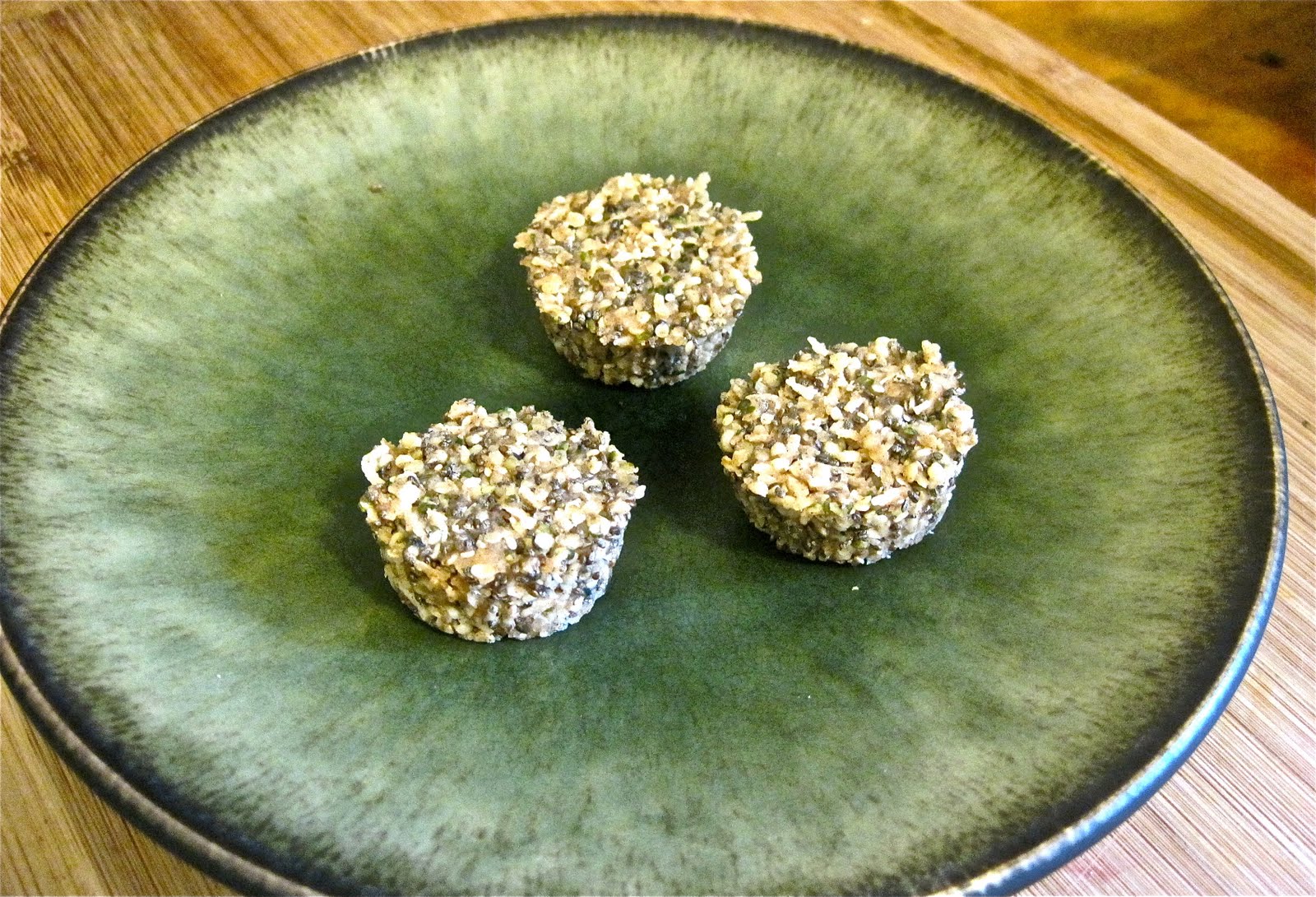
Cinnamon Coconut Hemp Cookies (LC/GF/Vegan)


Ingredients:

1/2 T coconut oil
1/2 T coconut manna
1/4 tsp pure vanilla extract
1/4 tsp cinnamon
2 tsp xylitol, powdered
7 g unsweetened dried coconut, finely shredded
1 T hemp seeds
1/2 T chia seeds


Preparation:

*Put coconut oil and manna in a small glass or ceramic bowl and microwave on high for 30 seconds. Whisk until thoroughly blended. Add the vanilla extract, xylitol, and the cinnamon and whisk until completely smooth. In a separate bowl, mix the coconut, hemp and chia seeds.  Mix the dry and the wet ingredient together. Spoon mixture into mold or drop spoonful of the mixture on a baking pan lined with parchment paper. Cover with another sheet of parchment paper and press down to flatten cookies. Chill in the freezer for 10 minutes and store in the refrigerator in an air-tight container.


Makes 3 cookies and each has  76.95 cal, 1.03 net carbs, 5.11 g fat, 1.41 g fiber ans 1.7 g protein.


Chocolate Coconut Haystacks (LC/GF/Vegan)


Ingredients:

1/2 T coconut oil
1/2 T coconut manna
1 T unsweetened cocoa powder
1/2 T erythritol, powdered
1 drop liquid stevia
14 g dried coconut, shredded


Preparation:

* Put coconut oil and manna in a small glass or ceramic bowl and microwave on High for 30 seconds. Whisk until thoroughly blended. Add cocoa powder, erythritol, vanilla extract and stevia, one at a time and whisk until smooth.  Mix in shredded coconut. Line a baking pan with unbleached parchment paper and drop mixture on by the spoonful  on the paper. Chill in the freezer fro 10 minutes. Store in the refrigerator in a air-tight container.

Makes 3 haystack and each has 76.5 cal, 1.5 net carbs, 8 g fat, 1.53 g fiber and 1.53 g protein.

Tuesday, March 22, 2011

For The Love of Leeks - Red Cabbage & Leek Soup (Low Carb/Gluten Free)


I didn't even know what, precisely, a leek really was until very recently. But since I have a tendency to get into a rut with certain vegetables, I've decided to be bold and to challenge myself to using ingredients that I previously knew nothing about. According to Wikipedia, leeks are a vegetable that belongs in the same family as onions and garlic (the Alliaceae family). When raw, they are extremely pungent - they will make your whole refrigerator reek. But when they are cooked, they become fragrant, with a delicate and flavorful taste that is milder and sweeter than onions. They are a good source of potassium, folic acid, and vitamin C.

My first attempt at cooking with leeks was brilliant. I had just learned about braising and had fallen in love with braised cabbage before stumbling upon a recipe for braised leeks, which tastes amazing, but may be  a little high in carbs if you're doing induction or ongoing weight loss. For those of you unfamiliar with stove top braising, it's basically a cross between sauteing and steaming, a process that allows you to  steam vegetables completely and get the caramelized flavor of a saute. Although there are number of vegetables that can be successfully braised (cabbage, celery, broccoli, turnips and brussels sprouts to name a few), my favorite is leeks,  mainly because they add flavor to previously uninspired dishes like this  red cabbage soup.


I was inspired to create this  recipe because I came across a recipe for red cabbage soup. It was easy to make, incredibly healthy, but really, really, really dull. Even though red cabbage has more flavor than the green, it isn't quite enough when used by itself. I'd used leeks before in soup, so I combined the two for a great success.


Red Cabbage and Leek Soup


Ingredients:

1 T extra virgen olive oil
1 oz trimmed leeks
2 C water
6 oz red cabbage
1/2 tsp sea salt


Let's start with the leeks themselves, to begin with. A whole leek looks like this:


The green leaves are inedible so you cut them off.


Then you trim the end, where the roots were:


Then cut the leak in half, lengthwise, and wash thoroughly.


When they're completely clean, shake off the excess water and cut them into small pieces and set aside.


Now here's the red cabbage. I know they look purple and when you cook them, they really get purple, but they're called red. No one put me in charge of naming the vegetables, so there you go. They are high in vitamin K and C and have a moderate amount of fiber.


Slice in half and remove the core. Then slice thinly and chop up into smaller pieces.


Weigh out 6 oz and set aside.


Using a medium sized soup pan, heat the olive oil over a medium high heat.


Add the leeks and saute for about 2 minutes (until they start to brown.


Then add 2 cups of water and bring to a boil. Add the cabbage, cover, lower the heat to low and simmer for 10 minutes.


While it's simmering, set up a colander placed over a medium sized bowl:


When soup is done, carefully pour into the colander. You don't want to lose any of the broth because that's where the nutrients are. The cabbage has the fiber but everything else is in the broth.


Set aside the cabbage and divide the liquid evenly between 2 containers.


Weigh the cabbage again and divide it evenly between the 2 containers.


This recipe makes 2 servings and each has 95 cal, 4.4 net carbs, 6.75 g fat, 3 g fiber and 3 g protein.

Obviously, you can double the recipe and make 4 servings - I'm not sure how it freezes, but it does OK in the fridge for a few days.


Sunday, March 20, 2011

The Accidental Vegetarian (How Protein Smoothies Saved My Life)


I hate tofu. I realize that this doesn't make me special, because a lot of people hate tofu. It's not the taste (as it has none), it's the texture.  I feel the same way about shirataki noodles - it's not just the smell, it's the slimy texture that I'd rather do without. But I used to happily incorporate other soy products into my diet, using unsweetened soy milk, soy flour, soy cereal and edamame. Then I found out about the truth about soy; it's a common allergin and it's negative impact on the human body can create all kinds of problems.
I was introduced to the excellent website of Maria Emmerich: mariahealth.blogspot .com, who has a great post on "soy's most glaring problems". Before reading this post:

http://mariahealth.blogspot.com/2011/03/salad-toppers-and-facts-on-mccormick.html#comments

I thought I was perfectly safe with organic, non - GMO soy, but I had no idea of the problems it can cause. To name of few:

*Soy contains natural toxins known as "anti-nutrients", that interfere with the enzymes needed to digest protein.
*Soy contains phytates, which prevent the absorption of minerals like calcium, magnesium, iron and zinc.
*Soy is packed with isoflavones, which are a type of phytoestrogen (a plant compound resembling human estrogen). Because they mimic estrogen, they can block the hormone which may disrupt endocrine function, can cause infertility and may promote breast cancer in women.

So there are good reasons for eliminating soy and fortunately, there are also other ways to incorporate protein into your diet if you don't or can't eat meat or soy.

I call myself an "accidental vegetarian" because I didn't begin doing low carb without eating meat. When I first started doing low carb, I not only ate meat, but regularly consumed food products loaded with artificial sweeteners and additives. But after a relatively short period of time,   I lost my craving for animal flesh. I'm still not sure why, but I was also making the gradual process of adapting whole foods into my diet. Most recently, I've gone gluten free and have eliminated soy from my diet. But another important aspect of my new found vegetarianism, is  the fact that over the last two years, I've been learning about the food industry and how it's unsavory practices put our health in danger and our economy and our ecology in peril. Most of the animals butchered for beef, pork and poultry products are raised in nightmarish conditions, their living quarters squeezed into the smallest possible space (to maximize profits), fed genetically modified corn (not their natural diet) and are given growth hormones (to maximize profits) and antibiotics (to keep them from getting sick from their terrible living conditions). I don't wan't to eat food that comes from those kind of conditions.  And I don't want to give my money to corporations where such vile business practices are considered standard operating procedures.

If you live in the right area, you can find meat that comes from local farms, from free range animals who live and eat in natural, humane conditions and don't get pumped full of growth hormones and antibiotics. They are, however, prohibitively expensive for most people, especially in this day and age. So how do I get enough protein in my diet? Protein powder! I don't think I would have made it through the first days of induction without it.

While smoothies are great anytime you need a quick boost of protein, they are especially great for breakfast - they can be prepared quickly and with the right ingredients, can be very filling.  However, it can be something of a challenge to make them taste good.  I recommend using unsweetened  almond milk instead of mixing protein powder with plain water.  Another option is to mix 8 oz of water with a 1/4 C of coconut milk;  it gives you a burst of energy, and is a great way to start your morning. A note about coconut milk - it does not keep well in the refrigerator so I separate out 1/4 C portions in airtight containers and freeze them.

What kind of protein powder should  you get?  You have several  options, but let's start with whey protein isolate.  There are loads of whey protein powders on the market, from companies that make all sorts of outrageous claims as to why they are the best. Never mind that they are filled  artificial additives, chemicals and who knows what else. So you want to look at quality, based on what your requirements are and how much you can afford. My requirements are as follows: it has to be 100 % natural whey protein isolate ( as apposed to whey protein concentrate ), it has to be sweetened with stevia, have no artificial additives or  growth hormones.  My reason for insisting on the isolate rather than the concentrate, is that is has more protein with less fat and less lactose per serving than concentrate. It's more expensive, due to it's higher quality, but I think it's worth it. To this end, I tried out everything I could find and ended up with SDC Nutrition's About Time Whey Protein Isolate, which I get in both vanilla and chocolate.


It's lactose and gluten free and has zero carbs and zero fat. And it does taste good and at $1.05, it's the least expensive of the high quality whey powders. I do have to order it online, but I may be able to get my grocery/health food store to order it fo me specially - some stores do and it's worth checking out to save time and money. There are also a number of whey protein powders sweetened with stevia available online and in many stores, that aren't 100 % natural, that don't have 100 % whey protein isolate, and aren't made from whey that is produced by cows that are hormone free. But there are some that don't seem too bad. They probably taste OK and aren't prohibitively expensive. Only you can decide what's best for you - for both your health and your wallet.


Here are some ideas and variations to get you started:


Chocolate Whey Smoothie


Ingredients:

1 scoop chocolate whey protein powder
1 C unsweetened vanilla almond (you can use hemp milk instead, if you wish)
A couple ice cubes (optional)

Preparation:

*Put ingredients in a blender and mix.

Makes one serving and has 141 cal, 2 net carb, 2.5 g fat, 0 g fiber and 25 g protein (using almond milk).


Variation:

1 scoop chocolate whey protein powder
1/4 C coconut milk
8 oz water
a couple of ice cubes, optional

This has 206 cal, 3.25 net carbs, 10.5 g fat, 0 fiber and 25.75 g protein.


Berry Whey Smoothie


You can use any kind of berries for this. Fresh fruit has less carbs but you can keep frozen berries in the freezer year round.

1 scoop vanilla whey protein powder
1 C unsweetened vanilla almond milk
36 g  frozen strawberries (or blueberries, raspberries or blackberries)


This has 161 cal, 4.25 net carbs, 2.5 g fat, .5 g fiber and 25 g protein.


Raw Smoothies

There are some disadvantages to raw food protein powders; they  have less protein per serving and don't taste as good as whey protein powder. But they have some advantages as well. Whey protein has no dietary fiber - 30 g of hemp protein has 9 g of fiber. If you are eliminating soy milk from your diet           ( I previously consumed  1 1/2 C per day, which comes out to 6 g fiber) this will more than compensate. Per serving, they have the 10 essential amino acids, the  omega 3 and 6 fatty acids and are an excellent source of magnesium and iron.

It can be something of a challenge to get them to be palatable: they are unsweetened, so you will need to add stevia or another natural low carb sweetener.  And you can add fruit, cocoa powder and spices to improve the taste. I've played around with different variations and have come up with a few recipes:


There are a few raw food powders that I like. There's Garden of Life Raw Protein:


It's made from a variety of sprouted grains and has 80 cal, 0 net carbs, 1 g fat, 3 g fiber and 18 g protein. It's around $1.21 per serving.


Then there are a couple of hemp protein powders. I can find this one at Berkeley Bowl, my supermarket/health food store:


Tempt  has 130 cal, 1 net carbs,  4 g fat, 9 g fiber and 13 g protein and is organic raw hemp protein powder.

And then there's my favorite:


It's basically the same as Tempt but it's produced by a company called Navitas Naturals. You can find them online at: http://www.navitasnaturals.com/.  They not only strive to make the best quality products with the least amount of processing, they are committed to environmentally and socially responsible business practices. Which is important to me. I order it through Amazon and by buying in bulk I can save money. It comes out to about $1.14 per serving.


Strawberry Hemp Smoothie


3 T hemp protein powder
36 g (about a 1/4 C) frozen strawberries
1 C unsweetened vanilla almond milk
stevia, to taste


It has 180 cal, 5.25 net carbs, 5.5 g fat , 6.5 g fiber and 17 g protein.


Chocolate Hemp Smoothie


1 C unsweetened almond milk
1 T unsweetened cocoa powder
3 T hemp protein powder
stevia, to taste


This has 172 cal, 4.4 net carbs, 6.7 g fat, 6 g fiber and 18 g protein.

And then I got the bright idea of mixing the two powders together. The result was not too bad - not as great as the whey by itself, but an improvement on the hemp by itself:


Chocolate Hemp/Whey Smoothie


15 g (2 T) chocolate whey protein powder
15 g (2 T) hemp protein powder
1 C unsweetened Vanilla almond milk


Has 155.5 cal, 1.5 net carbs, 5 g fat, 5.5 g fiber and 21.5 g protein.


Strawberry Hemp/Whey Protein Smoothie

15 g (2 T) vanilla whey protein powder
15 g (2 T) hemp protein powder
1 C unsweetened vanilla almond milk
36 g frozen strawberries


Has 175.5 cal, 4.75 net carbs, 4.5 g fat, 5 g fiber and 21.5 g protein.


A note about preparing smoothies: If you're just trying to mix protein powder with liquid, go ahead and use the "Magic Bullet" (or it's equivalent). But if you're adding ice cubes and frozen fruit, I'd recommend using a  real blender. I've heard too many horror stories about these machines breaking down because they don't have that capacity.  A decent blender may cost more, but it's worth it.